Power Financial Price To Earning vs. Operating Margin
Power Financial 51 Operating Margin vs. Price To Earning Fundamental Analysis
Peer multiple analysis evaluates Power Financial's pricing efficiency within its industry. Power Financial 51 ranks first in price to earning among leading competitors. It also ranks first in operating margin among leading competitors reporting about 0.01 of Operating Margin per Price To Earning. At 105.97 , Power Financial 51's Price To Earning-to-Operating Margin multiple reflects the spread between these metrics. Peer multiple benchmarking positions Power Financial within its competitive valuation range.Power Operating Margin vs. Price To Earning
Price to Earnings ratio is typically used for current valuation of a company and is one of the most popular ratios that investors monitor daily. Holding a low PE stock is less risky because when a company's profitability falls, it is likely that earnings will also go down as well. In other words, if you start from a lower position, your downside risk is limited. There are also some investors who believe that low Price to Earnings ratio reflects the low pricing because a given company is in trouble. On the other hand, a higher PE ratio means that investors are paying more for each unit of profit.
Power Financial |
| = | 7.28 X |
Generally speaking, the Price to Earnings ratio gives investors an idea of what the market is willing to pay for the company's current earnings.
Operating Margin shows how much operating income a company makes on each dollar of sales. It is one of the profitability indicators which helps analysts to understand whether the firm is successful or not making money from everyday operations.
Power Financial |
| = | 0.07 % |
A good Operating Margin is required for a company to be able to pay for its fixed costs or payout its debt, which implies that the higher the margin, the better. This ratio is most effective in evaluating the earning potential of a company over time when comparing it against a firm's competitors.
Power Operating Margin Comparison
Power Financial is currently under evaluation in operating margin among leading competitors.
Power Financial Profitability Projections
The most important aspect of a successful company is its ability to generate a profit. For investors in Power Financial, profitability is also one of the essential criteria for including it into their portfolios because, without profit, Power Financial will eventually generate negative long term returns. The profitability progress is the general direction of Power Financial's change in net profit over the period of time. It can combine multiple indicators of Power Financial, where stable trends show no significant progress. An accelerating trend is seen as positive, while a decreasing one is unfavorable. A rising trend means that profits are rising, and operational efficiency may be rising as well. A decreasing trend is a sign of poor performance and may indicate upcoming losses.
Power Financial Corporation provides financial services in Canada, the United States, Europe, and Asia. Power Financial Corporation is a subsidiary of Power Corporation of Canada. POWER FINANCIAL operates under Insurance - Life classification in Canada and is traded on Toronto Stock Exchange. It employs 28000 people.
Power Profitability Driver Comparison
Profitability drivers for Power Financial are the financial and operational factors that most directly influence its earnings. Investors must contend with a wide range of external shocks - from regulatory changes to commodity price swings - that can disrupt Power Financial's financial results.
Earnings per Share Projection vs Actual
Use Power Financial in pair-trading
Pair trading with Power Financial can help investors hedge some company-specific exposure by balancing a long view with an offsetting position. The advantage is that adverse movement in one leg may be partly offset by the other when correlation and thesis alignment hold.
Power Financial Pair Trading
Power Financial 51 Pair Trading Analysis
Using correlated positions as Power Financial substitutes during tax-loss harvesting allows investors to capture a tax benefit without disrupting portfolio allocation. The key is finding instruments that track Power Financial 51 closely enough to maintain equivalent risk and return.
The correlation of Power Financial with other assets is a key diversification metric. Pairing Power Financial 51 with uncorrelated or negatively correlated instruments can reduce overall portfolio volatility without necessarily reducing expected returns.
Correlation analysis and pair evaluation for Power Financial can support hedging context. The approach can be applied within sectors or across broader universes.Use Investing Themes to Complement your Power Financial position
Power Financial 51 Financial Services sector classification and 19.54 Billion mid-cap scale make it a natural anchor for themes targeting Insurance - Life exposure. For Power Financial 51 in Insurance - Life, the theme workflow defines the investment thesis first, then optimizes which Financial Services assets best express that view at the mid-cap level.
Did You Try This Idea?
Run Market Neutral Funds Thematic Idea Now
Market Neutral Funds
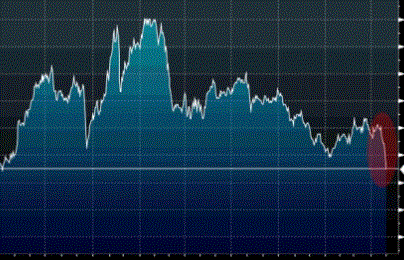
Funds or Etfs that invest in both long and short positions of different entities to enhance returns from broad market movements over time. The Market Neutral Funds theme has 39 constituents at this time.
The Market Neutral Funds Theme can be deployed as a buy-and-hold allocation or traded actively around individual position volatility.
| View All Next | Launch |
More Resources for Power Preferred Stock Analysis
Other Information on Investing in Power Preferred Stock
Projecting Power Financial's profitability begins with historical financial statements. The core view includes income statement, balance sheet, and cash flow.