Methode Electronics (Germany) Analysis
| ME5A Stock | EUR 7.30 0.15 2.01% |
200 Day MA 6.441 | 50 Day MA 6.257 | Beta 1.079 |
Methode Electronics has over 200,000 in debt which may indicate that it relies heavily on debt financing. The Methode Electronics' current Short Term Debt is estimated to increase to about 20.9 M, while Long Term Debt is projected to decrease to roughly 199.7 M. Methode Electronics' financial risk is the risk to Methode Electronics stockholders that is caused by an increase in debt.
Asset vs Debt
Equity vs Debt
Methode Electronics' liquidity is one of the most fundamental aspects of both its future profitability and its ability to meet different types of ongoing financial obligations. Methode Electronics' cash, liquid assets, total liabilities, and shareholder equity can be utilized to evaluate how much leverage the Company is using to sustain its current operations. For traders, higher-leverage indicators usually imply a higher risk to shareholders. In addition, it helps Methode Stock's retail investors understand whether an upcoming fall or rise in the market will negatively affect Methode Electronics' stakeholders.
For many companies, including Methode Electronics, marketable securities, inventories, and receivables are the most common assets that could be converted to cash. However, for Methode Electronics, the most critical issue when managing liquidity is ensuring that current assets are properly aligned with current liabilities. If they are not, Methode Electronics' management will need to obtain alternative financing to ensure there are always enough cash equivalents on the balance sheet to meet obligations.
Price Book 0.4516 | Enterprise Value Ebitda 16.5594 | Price Sales 0.2702 | Shares Float 34.9 M | Dividend Share 0.4 |
Given that Methode Electronics' debt-to-equity ratio measures a Company's obligations relative to the value of its net assets, it is usually used by traders to estimate the extent to which Methode Electronics is acquiring new debt as a mechanism of leveraging its assets. A high debt-to-equity ratio is generally associated with increased risk, implying that it has been aggressive in financing its growth with debt. Another way to look at debt-to-equity ratios is to compare the overall debt load of Methode Electronics to its assets or equity, showing how much of the company assets belong to shareholders vs. creditors. If shareholders own more assets, Methode Electronics is said to be less leveraged. If creditors hold a majority of Methode Electronics' assets, the Company is said to be highly leveraged.
The current Total Stockholder Equity is estimated to decrease to about 751.5 M. The Methode Electronics' current Other Stockholder Equity is estimated to increase to about (22.9 M). Methode Electronics is overvalued with Real Value of 5.82 and Hype Value of 7.26. The main objective of Methode Electronics stock analysis is to determine its intrinsic value, which is an estimate of what Methode Electronics is worth, separate from its market price. There are two main types of Methode Electronics' stock analysis: fundamental analysis and technical analysis. Fundamental analysis focuses on the financial and economic factors that affect Methode Electronics' performance, such as revenue growth, earnings, and financial stability. Technical analysis, on the other hand, focuses on the price and volume data of Methode Electronics' stock to identify patterns and trends that may indicate its future price movements.
The Methode Electronics stock is traded in Germany on Frankfurt Exchange, with the market opening at 08:00:00 and closing at 22:00:00 every Mon,Tue,Wed,Thu,Fri except for officially observed holidays in Germany. Here, you can get updates on important government artifacts, including earning estimates, SEC corporate filings, announcements, and Methode Electronics' ongoing operational relationships across important fundamental and technical indicators.
Methode |
Methode Stock Analysis Notes
About 94.0% of the company shares are owned by institutional investors. The company has price-to-book ratio of 0.45. Typically companies with comparable Price to Book (P/B) are able to outperform the market in the long run. Methode Electronics recorded a loss per share of 1.5. The entity last dividend was issued on the 16th of January 2026. Methode Electronics, Inc. designs, manufactures, and markets component and subsystem devices worldwide. The company was founded in 1946 and is headquartered in Chicago, Illinois. METHODE ELECTR operates under Electronic Components classification in Germany and is traded on Frankfurt Stock Exchange. It employs 6187 people. To find out more about Methode Electronics contact Donald Duda at 708 867 6777 or learn more at https://www.methode.com.Methode Electronics Quarterly Total Revenue |
|
Methode Electronics Investment Alerts
| Methode Electronics had very high historical volatility over the last 90 days | |
| Methode Electronics has high likelihood to experience some financial distress in the next 2 years | |
| The company reported the revenue of 1.05 B. Net Loss for the year was (62.6 M) with profit before overhead, payroll, taxes, and interest of 152.9 M. | |
| Over 94.0% of the company shares are owned by institutional investors | |
| Latest headline from news.google.com: Why Methode Electronics Is Lagging Sector Growth In Recent Quarters - Kalkine Media |
Methode Electronics Thematic Classifications
In addition to having Methode Electronics stock in your portfolios, you can add positions using our predefined set of ideas and optimize them against your very unique investing style. A single investing idea is a collection of funds, stocks, ETFs, or cryptocurrencies that are programmatically selected from a pull of investment themes. After you determine your favorite investment opportunity, you can then obtain an optimal portfolio that will maximize potential returns on the chosen idea or minimize its exposure to market volatility. If you are a result-oriented investor, you can benefit from optimizing one of our existing themes to build an efficient portfolio against your specific investing outlook.
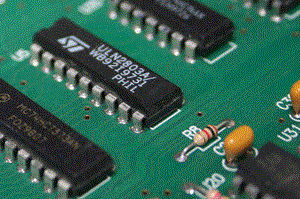 | ElectronicsElectronic manufacturers |
Methode Market Capitalization
The company currently falls under 'Small-Cap' category with a current market capitalization of 265.94 M. Market capitalization usually refers to the total value of a company's stock within the entire market. To calculate Methode Electronics's market, we take the total number of its shares issued and multiply it by Methode Electronics's current market price. To manage market risk and economic uncertainty, many investors today build portfolios that are diversified across equities with different market capitalizations. However, as a general rule, conservative investors tend to hold large-cap stocks, and those looking for more risk prefer small-cap and mid-cap equities.Methode Profitablity
Methode Electronics' profitability indicators refer to fundamental financial ratios that showcase Methode Electronics' ability to generate income relative to its revenue or operating costs. If, let's say, Methode Electronics is currently losing money, the management's focus should be on how to reverse that trend. However, when revenue exceeds expenses, Methode Electronics' executives or investors may be in less hurry to break that information down - which is where profitability analysis comes into play. Gaining a greater understanding of Methode Electronics' profitability requires more research than a typical breakdown of Methode Electronics' financial statements. By doing a profitability analysis, companies can identify areas needing attention, and investors can make a profitable trade.
The company has Profit Margin (PM) of (0.06) %, which may suggest that it does not properly executes on its current pricing strategies or is unable to control all of the operational costs. This is way below average. Similarly, it shows Operating Margin (OM) of 0.02 %, which suggests for every 100 dollars of sales, it generated a net operating income of $0.02. Management Efficiency
The current Total Assets is estimated to decrease to about 1.2 B. The current Net Tangible Assets is estimated to decrease to about 332.3 MMethode Electronics' management efficiency ratios could be used to measure how well Methode Electronics manages its routine affairs as well as how well it operates its assets and liabilities.Evaluating the management effectiveness of Methode Electronics allows investors to assess its financial health and operational efficiency. Coupled with an analysis of its growth prospects and the current market dynamics, we evaluate the stock's true value and future potential. Key indicators such as revenue, earnings or debt levels are examined alongside external factors like economic trends and regulatory changes. The Methode Stock analysis seeks to determine whether the stock is undervalued, appropriately priced, or overvalued, thereby guiding your investment decisions.
Technical Drivers
As of the 17th of February 2026, Methode Electronics secures the Risk Adjusted Performance of 0.1227, downside deviation of 3.71, and Mean Deviation of 2.4. In connection with fundamental indicators, the technical analysis model lets you check existing technical drivers of Methode Electronics, as well as the relationship between them. Please verify Methode Electronics maximum drawdown, potential upside, and the relationship between the treynor ratio and value at risk to decide if Methode Electronics is priced some-what accurately, providing market reflects its recent price of 7.3 per share.Methode Electronics Price Movement Analysis
java.lang.NullPointerException: Cannot invoke "java.lang.Number.intValue()" because the return value of "sun.invoke.util.ValueConversions.primitiveConversion(sun.invoke.util.Wrapper, Object, boolean)" is null. The output start index for this execution was zero with a total number of output elements of zero. The Bollinger Bands is very popular indicator that was developed by John Bollinger. It consist of three lines. Methode Electronics middle band is a simple moving average of its typical price. The upper and lower bands are (N) standard deviations above and below the middle band. The bands widen and narrow when the volatility of the price is higher or lower, respectively. The upper and lower bands can also be interpreted as price targets for Methode Electronics. When the price bounces off of the lower band and crosses the middle band, then the upper band becomes the price target.
Methode Electronics Outstanding Bonds
Methode Electronics issues bonds to finance its operations. Corporate bonds make up one of the largest components of the U.S. bond market, which is considered the world's largest securities market. Methode Electronics uses the proceeds from bond sales for a wide variety of purposes, including financing ongoing mergers and acquisitions, buying new equipment, investing in research and development, buying back their own stock, paying dividends to shareholders, and even refinancing existing debt. Most Methode bonds can be classified according to their maturity, which is the date when Methode Electronics has to pay back the principal to investors. Maturities can be short-term, medium-term, or long-term (more than ten years). Longer-term bonds usually offer higher interest rates but may entail additional risks.
| Methanex 565 percent Corp BondUS59151KAJ79 | View | |
| Methanex 525 percent Corp BondUS59151KAL26 | View | |
| METHANEX P 5125 Corp BondUS59151KAM09 | View | |
| MPLX LP 4125 Corp BondUS55336VAK61 | View | |
| US59155LAA08 Corp BondUS59155LAA08 | View | |
| METLIFE INC 65 Corp BondUS59156RAE80 | View | |
| METLIFE INC 6375 Corp BondUS59156RAJ77 | View | |
| US59156RAV06 Corp BondUS59156RAV06 | View |
Methode Electronics Predictive Daily Indicators
Methode Electronics intraday indicators are useful technical analysis tools used by many experienced traders. Just like the conventional technical analysis, daily indicators help intraday investors to analyze the price movement with the timing of Methode Electronics stock daily movement. By combining multiple daily indicators into a single trading strategy, you can limit your risk while still earning strong returns on your managed positions.
| Rate Of Daily Change | 0.98 | |||
| Day Median Price | 7.3 | |||
| Day Typical Price | 7.3 | |||
| Price Action Indicator | (0.07) | |||
| Period Momentum Indicator | (0.15) |
Methode Electronics Forecast Models
Methode Electronics' time-series forecasting models are one of many Methode Electronics' stock analysis techniques aimed at predicting future share value based on previously observed values. Time-series forecasting models ae widely used for non-stationary data. Non-stationary data are called the data whose statistical properties e.g. the mean and standard deviation are not constant over time but instead, these metrics vary over time. These non-stationary Methode Electronics' historical data is usually called time-series. Some empirical experimentation suggests that the statistical forecasting models outperform the models based exclusively on fundamental analysis to predict the direction of the market movement and maximize returns from investment trading.Methode Electronics Debt to Cash Allocation
Many companies such as Methode Electronics, eventually find out that there is only so much market out there to be conquered, and adding the next product or service is only half as profitable per unit as their current endeavors. Eventually, the company will reach a point where cash flows are strong, and extra cash is available but not fully utilized. In this case, the company may start buying back its stock from the public or issue more dividends.
Methode Electronics has accumulated 200 K in total debt with debt to equity ratio (D/E) of 42.4, indicating the company may have difficulties to generate enough cash to satisfy its financial obligations. Methode Electronics has a current ratio of 2.46, suggesting that it is liquid and has the ability to pay its financial obligations in time and when they become due. Debt can assist Methode Electronics until it has trouble settling it off, either with new capital or with free cash flow. So, Methode Electronics' shareholders could walk away with nothing if the company can't fulfill its legal obligations to repay debt. However, a more frequent occurrence is when companies like Methode Electronics sell additional shares at bargain prices, diluting existing shareholders. Debt, in this case, can be an excellent and much better tool for Methode to invest in growth at high rates of return. When we think about Methode Electronics' use of debt, we should always consider it together with cash and equity.Methode Electronics Total Assets Over Time
Methode Electronics Assets Financed by Debt
Typically, companies with high debt-to-asset ratios are said to be highly leveraged. The higher the ratio, the greater risk will be associated with the Methode Electronics' operation. In addition, a high debt-to-assets ratio may indicate a low borrowing capacity of Methode Electronics, which in turn will lower the firm's financial flexibility.Methode Electronics Corporate Bonds Issued
Most Methode bonds can be classified according to their maturity, which is the date when Methode Electronics has to pay back the principal to investors. Maturities can be short-term, medium-term, or long-term (more than ten years). Longer-term bonds usually offer higher interest rates but may entail additional risks.
Methode Long Term Debt
Long Term Debt |
|
About Methode Stock Analysis
Stock analysis is the technique used by a trader or investor to examine and evaluate how Methode Electronics prices is reacting to, or reflecting on a current market direction and economic conditions. It can be used to make informed decisions about market timing, and when buying or selling Methode shares will generate the highest return on investment. We also built our stock analysis module to help investors to gain an insight into the world economy as a whole, the stock market, thematic ideas. a specific sector, or an individual Stock such as Methode Electronics. By using and applying Methode Stock analysis, traders can create a robust methodology for identifying Methode entry and exit points for their positions.
Methode Electronics, Inc. designs, manufactures, and markets component and subsystem devices worldwide. The company was founded in 1946 and is headquartered in Chicago, Illinois. METHODE ELECTR operates under Electronic Components classification in Germany and is traded on Frankfurt Stock Exchange. It employs 6187 people.
Be your own money manager
As an investor, your ultimate goal is to build wealth. Optimizing your investment portfolio is an essential element in this goal. Using our stock analysis tools, you can find out how much better you can do when adding Methode Electronics to your portfolios without increasing risk or reducing expected return.Did you try this?
Run Cryptocurrency Center Now
Cryptocurrency CenterBuild and monitor diversified portfolio of extremely risky digital assets and cryptocurrency |
| All Next | Launch Module |
Complementary Tools for Methode Stock analysis
When running Methode Electronics' price analysis, check to measure Methode Electronics' market volatility, profitability, liquidity, solvency, efficiency, growth potential, financial leverage, and other vital indicators. We have many different tools that can be utilized to determine how healthy Methode Electronics is operating at the current time. Most of Methode Electronics' value examination focuses on studying past and present price action to predict the probability of Methode Electronics' future price movements. You can analyze the entity against its peers and the financial market as a whole to determine factors that move Methode Electronics' price. Additionally, you may evaluate how the addition of Methode Electronics to your portfolios can decrease your overall portfolio volatility.
| Portfolio Volatility Check portfolio volatility and analyze historical return density to properly model market risk | |
| Risk-Return Analysis View associations between returns expected from investment and the risk you assume | |
| AI Portfolio Prophet Use AI to generate optimal portfolios and find profitable investment opportunities | |
| Portfolio Center All portfolio management and optimization tools to improve performance of your portfolios | |
| Bollinger Bands Use Bollinger Bands indicator to analyze target price for a given investing horizon |