Applied Optoelectronics (Germany) Today
| A59 Stock | 39.20 3.80 10.73% |
PerformanceFair
| Odds Of DistressLow
|
Applied Optoelectronics is selling for under 39.20 as of the 2nd of February 2026; that is 10.73 percent increase since the beginning of the trading day. The stock's last reported lowest price was 34.0. Applied Optoelectronics has about a 20 % chance of experiencing some form of financial distress in the next two years of operation and did not have a very good performance during the last 90 trading days. The performance scores are derived for the period starting the 4th of November 2025 and ending today, the 2nd of February 2026. Click here to learn more.
Business Domain Technology Hardware & Equipment | Category Technology | Classification Information Technology |
Applied Optoelectronics is entity of Germany. It is traded as Stock on STU exchange. The company has 68.28 M outstanding shares. More on Applied Optoelectronics
Moving together with Applied Stock
| 0.76 | SSU | Samsung Electronics | PairCorr |
| 0.69 | TOMA | Toyota Motor Earnings Call This Week | PairCorr |
| 0.64 | 5EE | MEBUKI FINANCIAL Earnings Call This Week | PairCorr |
| 0.65 | 4FK | Fukuoka Financial Earnings Call This Week | PairCorr |
Moving against Applied Stock
Follow Valuation Profit Patterns Odds of Bankruptcy
Check how we calculate scores
Applied Stock Highlights
Most reasonable investors view market volatility as an opportunity to invest at a favorable price or to sell short against a bearish trend. Applied Optoelectronics' investment highlights are automatically generated signals that are significant enough to either complement your investing judgment regarding Applied Optoelectronics or challenge it. These highlights can help you better understand the position you are entering and avoid costly mistakes.
| Chairman, Founder | ChihHsiang Lin | ||||
| Thematic Idea | Electronics (View all Themes) | ||||
| Business Concentration | Communications Equipment, Technology Hardware & Equipment, Information Technology, Electronics, Information Technology, Communications Equipment, Semiconductors, Technology (View all Sectors) | ||||
Applied Optoelectronics' financial strength is of vital concern to both outside investors and internal stakeholders. Efficiency and cost control are keys to Applied Optoelectronics' success, along with its ability to generate sufficient cash flow to pay bills, repay debt, and make a consistent year-to-year profit. | |||||
Debt LevelsApplied Optoelectronics can leverage the use of borrowed funds to amplify returns from an investment. In general, analyzing the relationship between debt to total assets helps investors to understand Applied Optoelectronics' financial leverage. It provides some insight into what part of Applied Optoelectronics' total assets is financed by creditors.
| |||||
Applied Optoelectronics (A59) is traded on Stuttgart Exchange in Germany and employs 2,149 people. Applied Optoelectronics is listed under Communications Equipment category by Fama And French industry classification. The company currently falls under 'Mid-Cap' category with a current market capitalization of 2.5 B. Market capitalization usually refers to the total value of a company's stock within the entire market. To calculate Applied Optoelectronics's market, we take the total number of its shares issued and multiply it by Applied Optoelectronics's current market price. To manage market risk and economic uncertainty, many investors today build portfolios that are diversified across equities with different market capitalizations. However, as a general rule, conservative investors tend to hold large-cap stocks, and those looking for more risk prefer small-cap and mid-cap equities. Applied Optoelectronics operates under Communications Equipment sector and is part of Information Technology industry. The entity has 68.28 M outstanding shares.
Applied Optoelectronics generates negative cash flow from operations
Check Applied Optoelectronics Probability Of Bankruptcy
Ownership AllocationApplied Optoelectronics holds a total of 68.28 Million outstanding shares. Over half of Applied Optoelectronics' outstanding shares are owned by other corporate entities. These other corporate entities are typically referred to as corporate investors that acquire positions in a given instrument to benefit from reduced trade commissions. Consequently, these institutions are subject to different rules and regulations than regular investors in Applied Optoelectronics. Please watch out for any change in the institutional holdings of Applied Optoelectronics as this could mean something significant has changed or is about to change at the company. Please note that no matter how many assets the company secures, if the real value of the firm is less than the current market value, you may not be able to make money on it.
Check Applied Ownership Details
Applied Optoelectronics Historical Income Statement
Applied Stock Against Markets
Applied Stock Analysis Notes
About 64.0% of the company shares are held by institutions such as insurance companies. The company recorded a loss per share of 2.89. Applied Optoelectronics had not issued any dividends in recent years. For more info on Applied Optoelectronics please contact the company at 281 295 1800 or go to https://www.ao-inc.com.Applied Optoelectronics Quarterly Total Revenue |
|
Applied Optoelectronics Investment Alerts
| Applied Optoelectronics is way too risky over 90 days horizon | |
| Applied Optoelectronics appears to be risky and price may revert if volatility continues | |
| The company reported the revenue of 249.37 M. Net Loss for the year was (186.73 M) with profit before overhead, payroll, taxes, and interest of 123.7 M. | |
| Applied Optoelectronics generates negative cash flow from operations | |
| About 64.0% of the company shares are held by institutions such as insurance companies | |
| Latest headline from news.google.com: Applied Optoelectronics Shares Drop Amid Market Activitie - GuruFocus |
Applied Optoelectronics Thematic Classifications
In addition to having Applied Optoelectronics stock in your portfolios, you can add positions using our predefined set of ideas and optimize them against your very unique investing style. A single investing idea is a collection of funds, stocks, ETFs, or cryptocurrencies that are programmatically selected from a pull of investment themes. After you determine your favorite investment opportunity, you can then obtain an optimal portfolio that will maximize potential returns on the chosen idea or minimize its exposure to market volatility. If you are a result-oriented investor, you can benefit from optimizing one of our existing themes to build an efficient portfolio against your specific investing outlook.
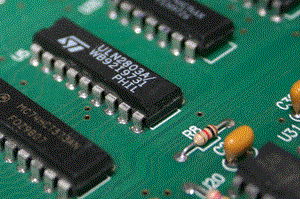 | ElectronicsElectronic manufacturers |
Applied Market Capitalization
The company currently falls under 'Mid-Cap' category with a current market capitalization of 2.5 B. Market capitalization usually refers to the total value of a company's stock within the entire market. To calculate Applied Optoelectronics's market, we take the total number of its shares issued and multiply it by Applied Optoelectronics's current market price. To manage market risk and economic uncertainty, many investors today build portfolios that are diversified across equities with different market capitalizations. However, as a general rule, conservative investors tend to hold large-cap stocks, and those looking for more risk prefer small-cap and mid-cap equities.Applied Profitablity
Applied Optoelectronics' profitability indicators refer to fundamental financial ratios that showcase Applied Optoelectronics' ability to generate income relative to its revenue or operating costs. If, let's say, Applied Optoelectronics is currently losing money, the management's focus should be on how to reverse that trend. However, when revenue exceeds expenses, Applied Optoelectronics' executives or investors may be in less hurry to break that information down - which is where profitability analysis comes into play. Gaining a greater understanding of Applied Optoelectronics' profitability requires more research than a typical breakdown of Applied Optoelectronics' financial statements. By doing a profitability analysis, companies can identify areas needing attention, and investors can make a profitable trade.
The company has Profit Margin (PM) of (0.37) %, which may suggest that it does not properly executes on its current pricing strategies or is unable to control all of the operational costs. This is way below average. Similarly, it shows Operating Margin (OM) of (0.15) %, which suggests for every $100 dollars of sales, it generated a net operating loss of $0.15. Management Efficiency
Applied Optoelectronics has return on total asset (ROA) of (0.0446) % which means that it has lost $0.0446 on every $100 spent on assets. This is way below average. Similarly, it shows a return on equity (ROE) of (0.4043) %, meaning that it generated substantial loss on money invested by shareholders. Applied Optoelectronics' management efficiency ratios could be used to measure how well Applied Optoelectronics manages its routine affairs as well as how well it operates its assets and liabilities. At this time, Applied Optoelectronics' Non Current Liabilities Other is comparatively stable compared to the past year. Change To Liabilities is likely to gain to about 15.7 M in 2026, whereas Total Current Liabilities is likely to drop slightly above 111.7 M in 2026.Leadership at Applied Optoelectronics emphasizes sustainable growth and financial prudence. Our analysis evaluates how these priorities impact the stock's performance in the market.
Technical Drivers
As of the 2nd of February, Applied Optoelectronics shows the Risk Adjusted Performance of 0.0888, mean deviation of 6.11, and Downside Deviation of 7.71. Applied Optoelectronics technical analysis gives you the methodology to make use of historical prices and volume patterns to determine a pattern that approximates the direction of the firm's future prices.Applied Optoelectronics Price Movement Analysis
Transformation |
The output start index for this execution was zero with a total number of output elements of sixty-one. Applied Optoelectronics Inverse Tangent Over Price Movement function is an inverse trigonometric method to describe Applied Optoelectronics price patterns.
Applied Optoelectronics Outstanding Bonds
Applied Optoelectronics issues bonds to finance its operations. Corporate bonds make up one of the largest components of the U.S. bond market, which is considered the world's largest securities market. Applied Optoelectronics uses the proceeds from bond sales for a wide variety of purposes, including financing ongoing mergers and acquisitions, buying new equipment, investing in research and development, buying back their own stock, paying dividends to shareholders, and even refinancing existing debt. Most Applied bonds can be classified according to their maturity, which is the date when Applied Optoelectronics has to pay back the principal to investors. Maturities can be short-term, medium-term, or long-term (more than ten years). Longer-term bonds usually offer higher interest rates but may entail additional risks.
| MPLX LP 52 Corp BondUS55336VAL45 | View | |
| APPLIED MATLS INC Corp BondUS038222AG04 | View | |
| APPLIED MATERIALS INC Corp BondUS038222AN54 | View | |
| APPLIED MATERIALS INC Corp BondUS038222AP03 | View | |
| APPLIED MATLS INC Corp BondUS038222AK16 | View | |
| APPLIED MATLS INC Corp BondUS038222AL98 | View | |
| APPLIED MATLS INC Corp BondUS038222AM71 | View | |
| MGM Resorts International Corp BondUS552953CD18 | View |
Applied Optoelectronics Predictive Daily Indicators
Applied Optoelectronics intraday indicators are useful technical analysis tools used by many experienced traders. Just like the conventional technical analysis, daily indicators help intraday investors to analyze the price movement with the timing of Applied Optoelectronics stock daily movement. By combining multiple daily indicators into a single trading strategy, you can limit your risk while still earning strong returns on your managed positions.
Applied Optoelectronics Forecast Models
Applied Optoelectronics' time-series forecasting models are one of many Applied Optoelectronics' stock analysis techniques aimed at predicting future share value based on previously observed values. Time-series forecasting models ae widely used for non-stationary data. Non-stationary data are called the data whose statistical properties e.g. the mean and standard deviation are not constant over time but instead, these metrics vary over time. These non-stationary Applied Optoelectronics' historical data is usually called time-series. Some empirical experimentation suggests that the statistical forecasting models outperform the models based exclusively on fundamental analysis to predict the direction of the market movement and maximize returns from investment trading.Be your own money manager
Our tools can tell you how much better you can do entering a position in Applied Optoelectronics without increasing your portfolio risk or giving up the expected return. As an individual investor, you need to find a reliable way to track all your investment portfolios. However, your requirements will often be based on how much of the process you decide to do yourself. In addition to allowing all investors analytical transparency into all their portfolios, our tools can evaluate risk-adjusted returns of your individual positions relative to your overall portfolio.Did you try this?
Run Efficient Frontier Now
Efficient FrontierPlot and analyze your portfolio and positions against risk-return landscape of the market. |
| All Next | Launch Module |
Applied Optoelectronics Corporate Management
Elected by the shareholders, the Applied Optoelectronics' board of directors comprises two types of representatives: Applied Optoelectronics inside directors who are chosen from within the company, and outside directors, selected externally and held independent of Applied. The board's role is to monitor Applied Optoelectronics' management team and ensure that shareholders' interests are well served. Applied Optoelectronics' inside directors are responsible for reviewing and approving budgets prepared by upper management to implement core corporate initiatives and projects. On the other hand, Applied Optoelectronics' outside directors are responsible for providing unbiased perspectives on the board's policies.
| David Kuo | Gen VP | Profile | |
| Jessica Hung | VP Controller | Profile | |
| Lindsay Savarese | Investor Relations | Profile | |
| Todd McCrum | Senior Access | Profile | |
| ShuHua Yeh | Senior Manager | Profile |
Additional Tools for Applied Stock Analysis
When running Applied Optoelectronics' price analysis, check to measure Applied Optoelectronics' market volatility, profitability, liquidity, solvency, efficiency, growth potential, financial leverage, and other vital indicators. We have many different tools that can be utilized to determine how healthy Applied Optoelectronics is operating at the current time. Most of Applied Optoelectronics' value examination focuses on studying past and present price action to predict the probability of Applied Optoelectronics' future price movements. You can analyze the entity against its peers and the financial market as a whole to determine factors that move Applied Optoelectronics' price. Additionally, you may evaluate how the addition of Applied Optoelectronics to your portfolios can decrease your overall portfolio volatility.